24 November 2025
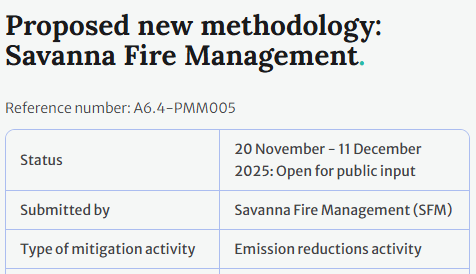
The development of internationally recognised methodologies for early dry-season savanna burning has taken an important step forward with the UNFCCC Supervisory Body formally approving the concept for the A6.4-PMM005 methodology under Article 6.4 of the Paris Agreement.
The approved concept note is now publicly available on the UNFCCC website: https://unfccc.int/A6.4-PMM005.
Why this matters
The Article 6.4 mechanism establishes a new, high-integrity global carbon market under the Paris Agreement. Concept approval signals that the Supervisory Body considers the proposed savanna-burning methodology to be technically robust and suitable to advance into the next stage of development. Only a limited number of proposals reach this point.
This milestone reflects growing international recognition that early dry-season fire management can:
Reduce emissions at scale
Strengthen ecosystem resilience
Support traditional burning practices
Deliver significant community and livelihood benefits
It also opens the door to a more detailed technical assessment focusing on baseline setting, permanence, leakage, monitoring, safeguards, and the integration of Indigenous knowledge and rights-based community benefits.
Update on Verra’s process
In parallel with the Article 6.4 advancement, Verra has confirmed that on Monday it will release a Request for Proposals (RFP) to commission an independent expert assessment of its updated savanna-burning methodology.
This is not yet the public consultation draft.
The consultation is expected to follow soon after the expert review has begun. ISFMI will continue to monitor developments closely and share updates as they become available.
Opportunities to provide comments
Deadline: 12 December 2025
Both the Article 6.4 process and the upcoming Verra consultation offer important opportunities for governments, Indigenous organisations, technical experts, and practitioners to help shape the next phase of methodology development.
We encourage stakeholders to submit comments by 12 December 2025, which marks the close of the 21-day consultation window following the Supervisory Body’s 21 November announcement.
Comments will help strengthen:
Alignment with national and regional priorities
Integration of Indigenous leadership and knowledge
Environmental integrity and feasibility
Monitoring and verification approaches
Social safeguards and benefit-sharing principles
ISFMI is available to provide support for preparing comments or technical briefing materials.